
Heritage
Guest post by Karen Renner


Hello! It’s Maggie. I host the Estranged newsletter on Substack. Today’s post is a personal essay from writer and academic Karen Renner. Enjoy!
My father and I haven’t been face-to-face in almost twenty years. My father lives in Germany. I haven’t lived in Germany since high school.
The last time I visited, I was thirty and distraught because a boyfriend had cheated on me; I’m fifty now and can’t remember why it bothered me so much. Come home to Daddy, he said then. The “Daddy” part was a joke, but the offer wasn’t.
I always thought my father and I would end up living in the same place, but then he got a girlfriend, and then he got her pregnant. I now have a half-brother over 30 years younger than me. I’ve only met his new family once, the last time I visited, twenty years ago.
The house they live in is not the one I grew up in, but I did call it home for a few summer and winter breaks during college. My parents have been separated for half of my life but never divorced, and my mother is still on the deed. My father says it’s because he’s “lazy.” I hate how flip he is. When I arrive, I notice there are no pictures of my father’s old family—my mother, my brother, me—anywhere. Later, I find a few in my father’s office.
My half-brother lets me sleep in his room. It’s an extension to the original house, with its own bathroom and a door that leads directly out to the back garden. He’s only known life as the sole child in this house, and now he’s sleeping on a cot upstairs. He’s nice enough, but I worry that he resents my presence: he seems to be taking particular pleasure in correcting my German.
My father sleeps on the couch. The dog, he says, is too anxious to climb the stairs to let them know he needs to go outside. During my visit, I learn that at my half-brother’s Abitur (high-school graduation), my father took a terrible fall on some stairs, one that required an ambulance and medics.
I act like a guest because I am one, but I wonder if I seem like a feudal lord come to inspect an abandoned estate and maybe lay claim. They probably assume I am my mother’s proxy. I am not. I haven’t seen my mother in twenty years either. She and my brother live in Australia, where they both were born and where she met my father. I’ll visit them next.
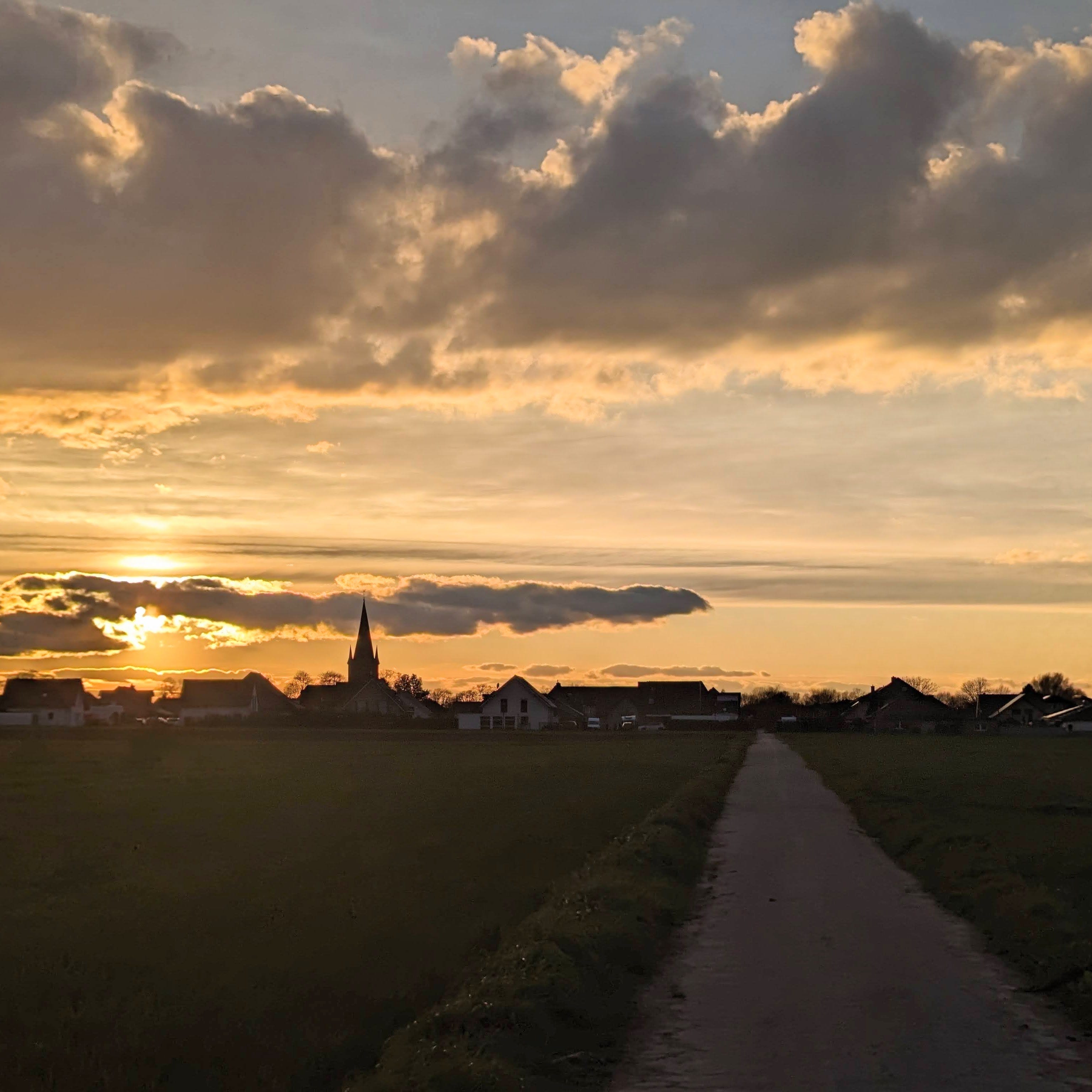
My father and I spend most of the four days we have together walking.
He used to run marathons, some under three hours, which means he averaged a mile every six and a half minutes. But now he is 84, and he can’t see very well, so he walks.
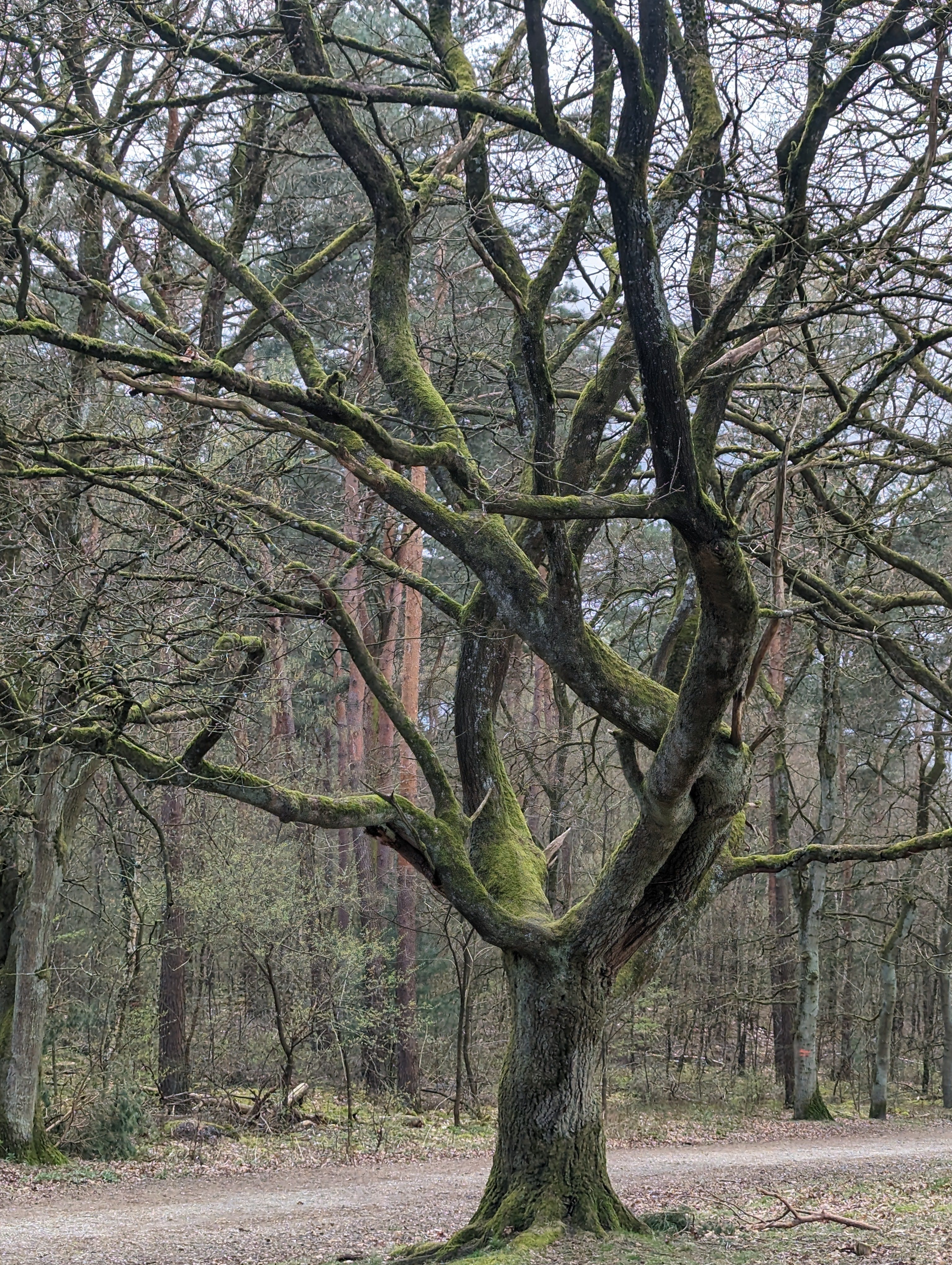
The first day, we walk in the Heide. Heide means “heath” in German. A “heath,” by definition, is an area of uncultivated land, but this Heide is cultivated, just for hiking and horse riding instead of farming.
Though it’s been decades since I’ve been in a German forest, I remember it in my bones, and it hurts to realize what I have forgotten: the smell of loamy soil, the way oak branches kink and sprawl. But there has been nothing to remind me: in the high desert of Flagstaff, where I’ve found myself living for the last 15 years, trees grow straight and tall, Ponderosa pine and aspen.
It’s a nice walk: my dad’s girlfriend keeps showing us how she has trained their dog to sit on things: a stump, a bench, a boulder.
Growing up, it was a horse I really wanted. My dad got me riding when I was three and put me in vaulting classes when we first moved to Germany, but he only bought his own after I was gone. Now it’s his girlfriend who cares for it, my father too unsteady to ride.
The second day we walk to Rimburg, just across the Dutch border, to see the Schloß. Schloß is the German word for “manor house.” This one was built in the eleventh century, on a Roman crossroads. I didn’t appreciate things like this when I lived here as a teenager. I know so little about the history.
On the way home, my father takes me to the bar they used to go to after riding. I would have been a part of this group had I stayed, but staying was never an option. I grew up in Department of Defense schools with Americans and Canadians, who left when they graduated, or earlier if their fathers’ posts ended before then. Back then, I could not have pictured making a life for myself in this rural town of 20,000; the glitz and glamor of the United States was far too great.
My father isn’t from here, either. His family fled to Nordrhein-Westfalen from East Germany in the 1950s. Like me, Dad was drawn to the US; he joined the German Airforce and was first stationed in El Paso. Five moves and 25 years later, he returned to Germany for good.
The final walk we take is planned: we will walk from this house to our old one, the last place my family—my father, my mother, me, and my brother—lived together. It’s not far, less than three miles one way, but people are surprised we don’t want a ride. I explain that I’ve forgotten the way and that’s why walking is necessary. There is a big hill before our house, and sometimes in my dreams I try to climb it but I can never remember what’s at the top. My memory’s map of the town has blank spots, and I want to fill them in.
It comes back instantly; it was never really gone. Some things have changed—there’s a McDonald’s now—but it’s still so much the same.
We take a selfie in front of the old house: the only picture we remember to take together the whole trip.
The last day of my visit falls on Easter. Not religious, I didn’t think of it, but I should have. Germans aren’t churchgoing, but they honor religious traditions. Shops remain closed on Sundays, and it’s still considered rude to mow your lawn or run a vacuum. Easter Sunday is that much more sacred. The house fills with guests, some from the stables, most my father’s girlfriend’s relatives. We sit at the big table and eat and drink for hours and hours, as is custom.
“Don’t you miss it here at all?” her sister asks, eyes teary, and I think it is me she feels sorry for, but I’m not sure.
“Ja,” I say. “Natürlich.” But when I am here, I miss it there, I want to explain, but I don’t have the words, and because they have always lived in one place, I’m not sure they will understand.
My visit has confused my father. He keeps speaking English instead of German, and he’s called my half-brother by my brother’s name several times now. It’s a relief to know we still loom large in his memory, even after all this time.
At one point, he announces that it’s my fault my name is spelled “Karen” and not “Karin.” This was a long-standing argument between my parents, who both insisted they wanted to spell my name in the traditional German way. If they agreed, why did I end up with the more boring version?
I gently remind him that I wasn’t even alive when that conversation was had.
He says he’s talking about a more recent fight, one we had “right here, at this table,” and I realize he’s mistaken me for my mother. I’ve never seen the resemblance, but last time I visited, her relatives kept saying how much I looked like a young version of her. Everyone turns to listen.
“It wasn’t me,” I say simply, and he realizes his mistake. His face falls a little, and he stares into his lap.
Someone starts a new conversation at the other end of the table.
I want to reach out and touch him, claim him, but he has already tsked away his mistake, scolded his age, returned to the conversation.
Later, when everyone’s gone home or to bed, I come out to see if he’s still awake, but he’s snoring on the couch. I stand over him, consider waking him anyway, but the dog, who doesn’t know me, begins to growl.
Karen J. Renner is a professor of English at Northern Arizona University and the author of Evil Children in the Popular Imagination, as well as more than 40 academic essays, chapters, and reviews. She is now focusing on cultural criticism and speculative fiction. https://www.karenjrenner.com/
 | A guest post by
|
I love “the way oak branches kink and sprawl.” Such a different way of seeing such a common tree. And the stinging inversion of her father mistaking a fight with her mother for a fight he had with her!